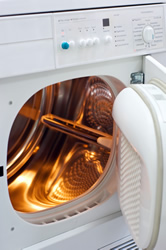
In 2006-2010, there were 16,950 home structure fires per year reported to U.S. fire departments where clothes dryers or washing machines were the equipment involved in ignition, with associated annual losses of 34 civilian deaths, 430 civilian injuries, and $209 million in direct property damage. Dryers alone accounted for 92% of these fires and 87% of the reported deaths.
The leading factor contributing to ignition was a failure to clean the clothes dryer. The risk of fire is roughly equal for gas-fueled clothes dryers and electric-powered clothes dryers.
Follow these simple steps to help prevent a clothes dryer fire:
Have your dryer installed and serviced by a
professional.
Do not use the dryer without a lint filter.
Make sure you clean the lint filter before or after
each load of laundry. Remove lint that has collected
around the drum.
Rigid or flexible metal venting material should be
used to sustain proper air flow and drying time.
Make sure the air exhaust vent pipe is not restricted
and the outdoor vent flap will open when the dryer
is operating. Once a year, or more often if you
notice that it is taking longer than normal for your
clothes to dry, clean lint out of the vent pipe or
have a dryer lint removal service do it for you.
Keep dryers in good working order. Gas dryers
should be inspected by a professional to make sure
that the gas line and connection are intact and free
of leaks.
Make sure the right plug and outlet are used and
that the machine is connected properly.
Follow the manufacturer’s operating instructions
and don’t overload your dryer.
Turn the dryer off if you leave home or when you
go to bed.